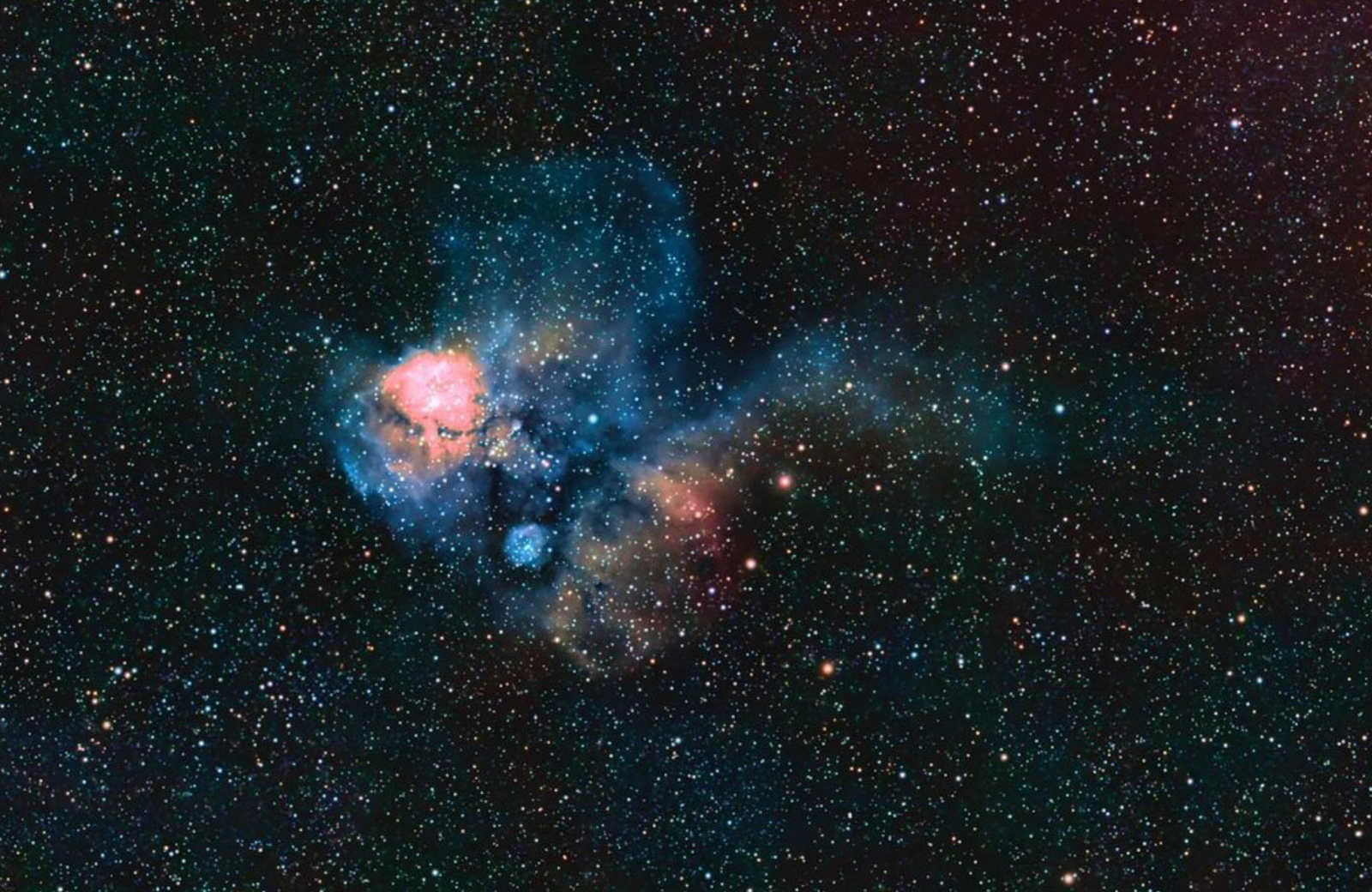
You step outside on a clear night. The sky is cloudless. You look up and see… ten, maybe fifteen stars. A vague smudge that might be the moon. A few blinking dots that are almost certainly planes.
That’s it.
If you grew up in a city or a large town, this is probably all you’ve ever known. And because of that, you might have assumed the night sky was always like this. A black canvas with a handful of visible stars, nice enough, nothing special.
It isn’t. What you’re seeing is a broken sky. And the thing that broke it has a name.
What light pollution actually is
Light pollution is artificial light that escapes upward and sideways into the atmosphere instead of illuminating what it was designed to illuminate. Streetlights, shop fronts, office buildings left on overnight, sports stadiums, car headlights: all of it sends photons in every direction, including up.
Once that light hits the atmosphere, it scatters. Tiny particles of dust, water vapor, and gas bounce the light around and create a diffuse glow over any inhabited area. This is called skyglow, and it’s what you see from the highway when you’re approaching a city at night: that orange-pink dome sitting over the skyline.
Skyglow doesn’t just affect the sky directly above a city. It spreads. A large city can wash out stars across a radius of 100 kilometers or more. Which means that if you live within a couple of hours of a major urban center (and most people do), the sky above your garden is already compromised.
Why you can’t see stars from where you live
The answer, almost always, is skyglow.
Here’s a useful way to think about it. The human eye can detect an extraordinary range of brightness. But it works by adjusting to the ambient light level around it. In a dark room, your pupils dilate and your retinal cells shift into a highly sensitive mode. In a bright room, they do the opposite.
When you stand in your garden at night in a city, the sky around you isn’t actually dark. It’s glowing faintly orange or gray from reflected artificial light. Your eyes adapt to that ambient level. And because the sky itself is the “bright” backdrop, the fainter stars simply don’t register. They’re there. Your eyes just can’t pick them out against the noise.
It’s similar to trying to hear a whisper in a loud room. The sound exists. The signal is just drowned out.
The Milky Way, our own galaxy, is invisible from any location with a Bortle rating above 4 or 5. That includes virtually every city on Earth, and most towns. Roughly one third of humanity has never seen the Milky Way. Not because they haven’t looked. Because the sky above them simply doesn’t allow it anymore.
How bad is the problem, really?
Bad, and getting worse.
A major scientific study published in Science found that the night sky is brightening at roughly 10% per year. That might sound small, but compounded over a decade, it’s enormous. Locations that were considered “dark” twenty years ago are now measurably brighter.
The shift to LED lighting, which seems environmentally positive (and is, in some ways), has actually made the problem worse in terms of light scatter. LED lights emit more blue-spectrum light than older sodium streetlights, and blue light scatters more efficiently in the atmosphere. The sky gets brighter even as individual lights become more efficient.
For astronomers, this is a professional crisis. For the rest of us, it’s a quieter kind of loss. Something most people don’t even know they’re missing.
What you actually lose when the stars disappear
This isn’t just about aesthetics, though the aesthetics matter.
For most of human history, the night sky was the shared reference point of every culture on Earth. Navigation, agriculture, mythology, religion, philosophy: all of it developed in relationship to the stars. The Polynesian sailors who crossed the Pacific used the stars to find islands the size of a dot on a map. Every ancient civilization from Egypt to Mesoamerica to Mesopotamia built its calendar around the sky.
That connection didn’t disappear because we decided it wasn’t important. It disappeared because we turned on the lights and forgot to look up.
There’s also a practical ecological cost. Artificial light at night disrupts the behavior of nocturnal animals, confuses migratory birds, interferes with insect reproduction, and disrupts plant growth cycles. Light pollution is an environmental problem, not just an astronomical one.
And then there’s the human cost. Studies suggest that chronic exposure to artificial light at night disrupts circadian rhythms and melatonin production, with potential effects on sleep quality and long-term health. The night was supposed to be dark. Our bodies were designed for it.
How to avoid light pollution: your practical options
If you want to see a genuinely dark sky, you have a few paths forward.
Find a certified dark sky location near you
The International Dark-Sky Association (IDA) certifies parks, reserves, and communities that meet strict standards for low light pollution. There are dark sky parks on every continent. In Europe, good examples include Exmoor National Park in England, the Cévennes in France, and Fuerteventura in the Canary Islands (the first island in the world to receive Starlight certification).
These are worth visiting. The limitation is that “near you” is doing a lot of work in that sentence. For most city dwellers in Europe, the nearest certified dark sky location still requires a dedicated trip, often a few hours by car, and usually rural accommodation.
Go to a high altitude
Higher altitude means less atmosphere between you and the stars, which means less scattering. Mountain locations in places like the Alps, the Pyrenees, or the Sierra Nevada can offer noticeably darker skies than the valleys below them. Still limited by regional skyglow, but better than ground level.
Travel to one of the world’s designated dark sky islands
A handful of islands have committed at the policy level to protecting their night skies. La Palma in the Canary Islands was the first territory in the world to pass a law protecting the sky above it. Fuerteventura and El Hierro followed. Madeira’s surrounding ocean provides natural isolation from light sources.
These islands are reachable by direct flight from most of Europe in three to four hours. The infrastructure is modern. The skies are measurably, genuinely dark. And if you combine the destination with a sailing stargazing experience, you also solve the last-mile problem: getting away from the coastal towns and resorts that still generate some light, and out onto the water where there’s nothing between you and the sky.
Get on the water
This is the option that most people overlook, and the one that tends to produce the most powerful results.
Even in places with good dark-sky protection, the coast itself generates light. Marinas, restaurants, resort hotels, fishing boats: there’s always some ambient glow near shore. When you sail a few miles offshore, you leave all of that behind. The coast becomes a thin line of light on the horizon, and then it disappears entirely.
On the water, you also get a complete horizon. No hills, no tree line, no buildings. The sky reaches all the way down to the sea in every direction. Combined with the reflection of the stars on calm water, it creates an immersive experience that no land-based location can quite replicate.
The best dark sky locations in the Atlantic: why these islands matter
The Canary Islands, Madeira, the Azores, and Martinique aren’t just scenic Atlantic destinations. They’re among the best places in the world to escape light pollution, for a combination of reasons that are hard to find anywhere else:
Isolation. These archipelagos sit far enough from the European and African mainland that regional skyglow doesn’t reach them at sea level.
Climate. High percentages of clear nights, low humidity, and trade winds that sweep the atmosphere clean.
Policy protection. Several of these islands have active legislation protecting their night skies, which means the situation is stable and in some cases improving.
Accessibility. Three to four hours from most of Western Europe. No altitude acclimatization. No extreme cold. No need for specialist equipment.
For anyone in Europe who wants to see a genuinely dark sky without crossing an ocean or ascending a mountain, this corner of the Atlantic is the answer.
You don’t need to wait for a perfect dark sky reserve
Here’s the thing about light pollution: you can’t fix it from your garden.
But you can leave it behind, and it doesn’t have to be a complicated expedition to do it.
A single night on the water, a few miles offshore from one of these islands, is enough to see the Milky Way with your own eyes. To understand, in a way that’s physical and not just intellectual, what the night sky actually looks like.
At Atlantic Star Adventures, that’s exactly what we offer.
Sailing and stargazing experiences across the Atlantic, designed for people who have never done this before and want to do it right.
You can check our experiences here, and start with the one closest to you today
The sky hasn’t gone anywhere. You’ve just never had the chance to get far enough from the light to find it.