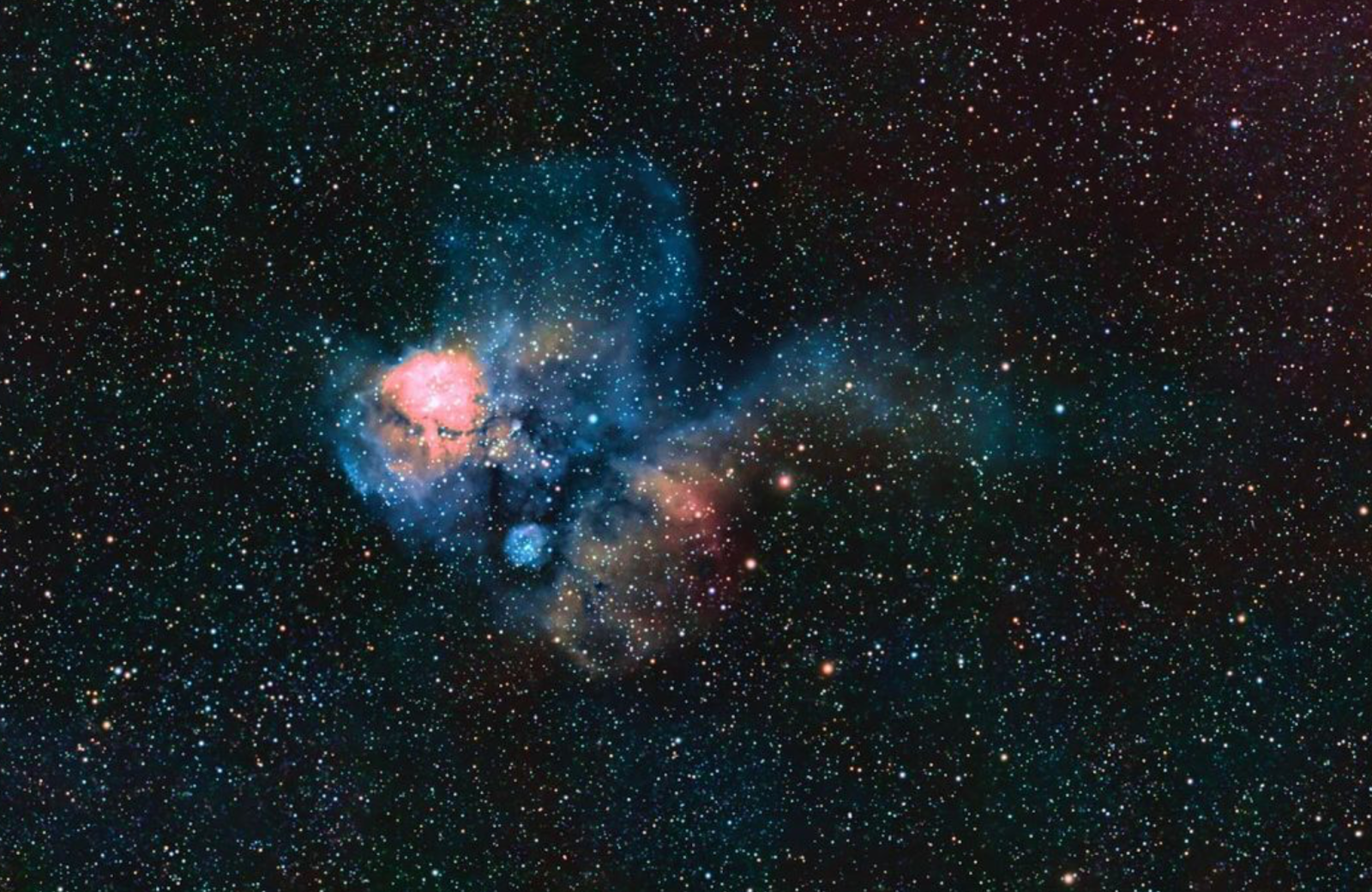
You’ve seen photos of it. That river of light stretching from one side of the sky to the other, dense in the center, fading at the edges, impossibly beautiful. You’ve probably assumed it was taken with expensive equipment, in some remote corner of the world, by someone who really knows what they’re doing.
Here’s the truth: you can see the Milky Way with your naked eye. No camera, no telescope, no astronomy background. Just you, a dark sky, and a few things to know before you go.
This guide covers all of it, step by step.
What is the Milky Way, exactly?
Before we get into the how, a quick bit of context, because it makes the experience more powerful when you understand what you’re actually looking at.
The Milky Way is our galaxy. A barred spiral structure containing somewhere between 100 and 400 billion stars. Our Sun is one of them, sitting roughly 26,000 light years from the center, in one of the outer spiral arms.
When you look up at the Milky Way from Earth, you’re not looking at it from outside. You’re looking at it from inside. What appears as a wide, luminous band across the sky is actually the disc of the galaxy seen edge-on. You’re looking along the plane of the disc, where the density of stars is highest, toward the galactic core.
That core, the brightest and most dramatic part, sits in the direction of the constellation Sagittarius. It looks like a thick column of smoke made of light, with darker lanes of dust running through it. And it is genuinely one of the most astonishing things a human being can see with unaided eyes.
Most people alive today have never seen it. Not because it isn’t there. Because they’ve never been in the right place at the right time to find it.
When is the best time to see the Milky Way?
The Milky Way is visible from Earth all year round, but the galactic core (the part you actually want to see) is only above the horizon for part of the year. And timing matters a lot.
The Milky Way season runs from roughly February to October in the northern hemisphere. Outside those months, the galactic core is below the horizon at night, hidden on the other side of Earth.
Peak viewing is June, July, and August. The core is high in the sky, visible from dusk to dawn, and reaches its highest point around midnight. These are the months that give you the most sky for the least effort.
In spring (March to May), the core rises in the early hours before dawn. It’s there, but you need to be willing to stay up late or get up early. In autumn (September to October), it sets increasingly early in the evening. Still visible, but the window is shorter.
Moon phase is just as important as season. A full moon is basically a giant floodlight in the sky. It drowns out the Milky Way the same way a streetlamp drowns out a candle. For a genuinely dark sky, you want to be out within a few days of the new moon, when the moon is either below the horizon or so thin it casts almost no light.
Plan around both. A clear night in June near the new moon is worth more than a perfect location on any other night.
What conditions do you need to see the Milky Way?
Three things, in order of importance:
1. No light pollution. This is the deal-breaker. You cannot see the Milky Way from a city, a town, or anywhere near significant artificial lighting. The skyglow from human settlements scatters into the atmosphere and washes out the faintest stars. The Milky Way, for all its billions of stars, is diffuse and relatively faint. It needs darkness to show itself.
On the Bortle Dark-Sky Scale (a nine-point scale measuring sky brightness, where 1 is pristine darkness and 9 is the center of a city), you need to be at a 4 or below to see the Milky Way clearly. Most people spend their entire lives under a Bortle 6, 7, or 8 and have no idea what they’re missing.
2. No moon, or a very thin crescent. As above. Check the lunar phase before you go. New moon nights and the days immediately around them are gold.
3. Clear sky. Cloud cover is obvious, but even thin high-altitude haze can reduce the contrast enough to make the Milky Way disappear. A weather app that shows cloud cover by hour is worth checking the night before.
That’s it. No equipment, no special skills. If you have those three conditions, you will see it.
Where to see the Milky Way: from fields to the open ocean
This is where most guides stop at the obvious answer: go to a national park, a dark-sky reserve, find a field far from town. That advice is correct. But it’s incomplete.
The typical approach: drive to a dark sky location
Most guides recommend driving 50 to 150 kilometers from your nearest city, finding open land away from roads, and letting your eyes adjust. If you live in Europe, destinations like the South Downs in England, the Cévennes in France, or the Sierra Nevada in Spain can work on a good night.
The limitation is consistency. Cloud cover in Northern and Central Europe is unpredictable. Clear nights can be rare, especially in autumn and winter. And even in a dark-sky park, you’re still within some distance of civilization, which means there’s always some ambient glow on the horizon.
The better approach: an island with protected dark skies
A step up from a rural field is a certified dark-sky island. Several in the Atlantic have actual legislation protecting their night skies from light pollution.
La Palma in the Canary Islands was the first territory in the world to pass a law protecting its sky. Fuerteventura has Starlight Reserve certification. El Hierro is among the darkest places in Europe. These islands sit far enough from the European and African mainland that regional skyglow doesn’t reach them, and the trade winds that sweep across thousands of kilometers of open ocean before arriving keep the atmosphere clean and transparent.
Reachable by direct flight from most European cities in three to four hours. Stable climate. High percentage of clear nights. A big step up from chasing clear skies in Northern Europe.
The best approach: get out on the water
Here’s what most guides don’t tell you, and what makes the biggest practical difference.
Even on a dark-sky island, the coast has light. Marinas, restaurants, hotels, fishing boats. There’s always something. And on land, you always have an imperfect horizon: hills, buildings, trees cutting into the lower sky where some of the best constellations rise and set.
When you sail a few miles offshore, both problems disappear at once. The coastal glow shrinks behind you. The horizon opens up to a full 360 degrees of ocean in every direction. The sky is fully visible from the water’s surface all the way overhead. And the reflection of the stars on a calm sea adds a dimension to the experience that simply can’t exist on land.
The Milky Way reflected in still water, seen from an open boat with no artificial light in any direction, is not something you forget. It’s the kind of thing people describe as genuinely life-changing, which sounds like an exaggeration until you’re actually there.
Common mistakes that stop people from seeing the Milky Way
Looking at your phone. Your eyes need 20 to 30 minutes to fully dark-adapt. One glance at a bright screen resets the process. If you must use a light, use a red one: red wavelengths don’t disrupt night vision the way white or blue light does.
Going on the wrong night. A full moon, a partly cloudy night, or the wrong time of year will ruin even the best location. The conditions matter more than the destination. A mediocre location on a perfect night beats a perfect location on a bad one.
Not giving it time. People step outside, look up for two minutes, and feel underwhelmed. The Milky Way reveals itself gradually. Give your eyes time to adjust. Let the scale of what you’re seeing sink in. Fifteen or twenty minutes of patient looking is when the experience shifts from “nice” to “unforgettable.”
Expecting what photos show. Long-exposure astrophotography captures light over minutes, amplifying color and detail far beyond what the human eye can see. The Milky Way to the naked eye looks like a wide, luminous band of pale light, dense with texture but without the vivid colors of photos. It’s still extraordinary. Just different. Go in with accurate expectations.
Using a telescope. This is counterintuitive, but a telescope is useless for seeing the Milky Way. It magnifies a tiny patch of sky. The Milky Way spans the entire sky. Binoculars are useful for exploring detail. Your naked eye is the right instrument for the whole picture.
From land, it’s hard. From the ocean, it’s another level entirely
Getting to a Bortle 3 sky from most European cities involves either a long drive into rural darkness (and hoping the clouds cooperate) or a flight to a dark-sky island (and hoping you have transport and time to get somewhere truly dark once you land).
Getting on a boat just a few miles offshore from a dark-sky island like La Palma, Madeira, or Gran Canaria solves all of it in one step. The darkness is immediate. The horizon is infinite. And instead of standing in a field somewhere trying to navigate a star chart on your own, you have an expert guide on board who can tell you exactly what you’re looking at, point out the constellations, explain what the galactic core actually is, and answer every question you didn’t know you had.
It’s the difference between reading about something and actually experiencing it.
At Atlantic Star Adventures, every sailing experience is designed with exactly this in mind: getting people who have never seen a real dark sky somewhere they can finally see one, with guidance, comfort, and a level of sky that most Europeans will never encounter any other way.
👉 See our stargazing sailing experiences in Madeira, the Canary Islands, the Azores, and Martinique
The Milky Way has been there your whole life. You just need the right night, the right water, and to get far enough from the lights to finally find it.